
Vacation rental journal
Vacation Rental Accessibility: Questions to Ask Before You Book
An “accessible” label cannot tell you whether a particular traveller can get from the car to the bed, use the bathroom or leave the property if an…
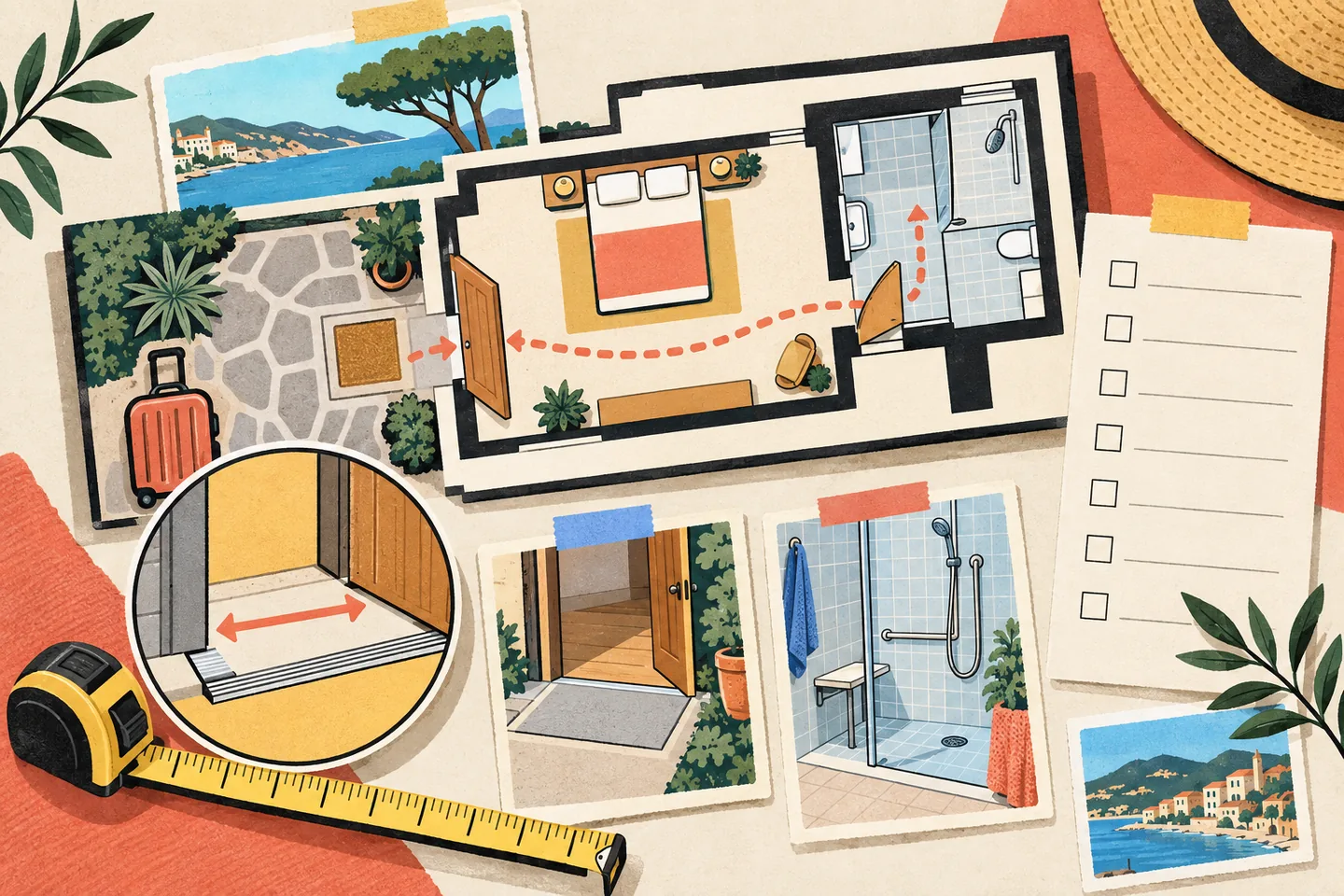
An “accessible” label cannot tell you whether a particular traveller can get from the car to the bed, use the bathroom or leave the property if an essential lift stops working. Those answers depend on the route through the home and the traveller’s equipment and transfer needs. Ask for a connected description of the stay, supported by photographs and measurements. A step-free shower upstairs, for example, does little for someone who cannot use the stairs.
Define the route the traveler needs
Write down the traveller’s requirements before searching. Note the width of any wheelchair, walker or other mobility device at its widest point; the space needed to turn or transfer; whether assistance is available; and which rooms must be reachable without steps. Include details photographs may not reveal, such as the side from which a bed must be approached.
Begin the route where the traveller will arrive: a driveway, parking space, kerbside drop-off or apartment entrance. Follow the ground surface through gates and shared corridors, into a lift if needed, over the rental’s threshold and on to the bedroom, bathroom and living area. Trace kitchen or outdoor routes if they matter to the stay.
Record each link separately. “Ground-floor bedroom” does not establish that the path to it is level; “lift building” does not rule out a step between the lift and the unit. The U.S. Department of Justice’s hotel reservation guidance emphasises descriptions of entrances, travel paths and room features detailed enough for guests to assess their own needs. Use that approach to frame questions, without assuming hotel rules apply to every holiday rental. Read the Department of Justice’s lodging guidance.
Use filters to find candidates, then inspect the evidence
Accessibility filters can narrow a search, but they cannot decide whether a home fits one person’s needs. Airbnb describes feature filters and a way to message hosts; use both to identify questions for a specific listing. See Airbnb’s accessibility overview.
Look beyond the main gallery for feature photographs and captions. Airbnb asks hosts to show accessibility features with clear photos and, for certain features, measurements. Its doorway criteria call for a tape measure across the open doorway with the numbers visible; its step-free access criteria address the route from arrival to the entrance. See Airbnb’s feature definitions and photo criteria.
Ask for the clear opening with a door open as far as it will normally go, rather than the width of its panel. A photograph should show the tape and narrowest usable point. For a threshold, ask for a close view from both sides with a ruler beside the rise. For the approach, request a sequence from arrival to entrance. A floor plan may help connect rooms, but can omit furniture, door swings and small level changes. Confirm any decisive measurement against the current layout.
Check the route in both directions. A slope that looks manageable on arrival may be difficult when leaving with luggage or in wet conditions. Ask whether exterior paths are paved, firm or loose, and whether gates can be opened from the traveller’s seated position. In an apartment building, distinguish the shared entrance from the unit entrance: each may have a different threshold, door closer or access code. If a lift is essential, ask which floor it reaches and whether any steps remain after exiting it.
Check the bathroom and sleeping area closely
Identify the bathroom the traveller would use and whether it is on the same usable route as the bedroom. Ask for its clear doorway width, space beside the toilet, location of fixed grab bars and a wide photograph showing the door, toilet, sink and shower together. A close-up of a grab bar cannot show whether it is on the side needed for a transfer.
“Walk-in” and “step-free” do not fully describe a shower. Ask whether there is a lip, water guard or track at the opening, and its measured height. Confirm usable floor space, whether a suitable chair is provided or the traveller’s own chair can fit, and where the controls and shower head sit.
In the bedroom, ask which side of the bed has open floor space, how much, and the height of the sleeping surface if a transfer is needed. Identify the exact bedroom shown; do not assume furniture can be rearranged.
Check how the traveller will use the space, not just enter it. A turning area beside the bed may be occupied by a chair; a shower seat may block the controls; a bathroom door may swing into the only transfer space. Ask for one wide photograph from the doorway and another from inside each critical room. If a portable ramp or shower chair is mentioned, confirm where it will be kept, who will set it up and whether its dimensions suit the required route. Do not count movable equipment as available until the host confirms it for the stay.
A room-by-room verification worksheet
For each promising property, mark each item confirmed, needs evidence or does not fit. Record the traveller’s required dimensions beside those offered. Resolve blank answers before booking.
- Arrival and parking: Where will the traveller get out? Is there room to unload equipment? Are there kerbs, slopes, loose gravel or gates between there and the entrance?
- Building approach: Are there steps? If a lift is needed, does it serve every required level? What route is usable if it stops working?
- Entrance: What is the clear door opening? How high is the threshold on each side? Is there room to approach, open and pass through the door?
- Interior route: Which rooms are reachable? What are the narrowest passage and doorway? Are there raised transitions?
- Bathroom: Which bathroom will be used? Is there enough space for the required approach and transfer? Where are fixed grab bars?
- Shower: Is there a lip or track, and how high? Is a suitable seat available, or space for the traveller’s own equipment?
- Sleeping area: Which bed is on the usable route? What are its height and clear approach space, including the side needed for transfer?
- Essential backup: If a lift or ramp cannot be used, is there another usable route? Who handles a problem during the stay?
For each confirmed item, note the supporting photograph, measurement or written reply. Keep answers with the booking record.
Send a short, specific message before booking
Ask about the route and measurements that matter, without asking the host to judge the traveller’s abilities. Request photographs for gaps the listing has not resolved. If several people manage the property, ask the respondent to verify uncertain measurements at the unit.
Hello, I’m considering your rental for a traveller who needs a step-free route from arrival to a bedroom, bathroom and living area. Could you confirm where we would park or be dropped off; whether that route has steps or raised thresholds; the clear opening widths of the entrance, bedroom and bathroom doors; and the height of any thresholds or shower lip? If a lift is essential, is there another usable route when it is unavailable? Photos of the route, bathroom layout and measurements would help us assess the space. Thank you.
Adapt the message to the traveller. Add bed approach or transfer details if decisive, and follow up on broad answers: “no stairs inside” leaves the path from parking unresolved.
Decide from the weakest required link
Walk through arrival and an overnight stay using the evidence gathered. Can the traveller enter, use the toilet, bathe if needed and reach the bed? Does every essential doorway and transfer space meet that person’s requirements? Seek a measurement or clearer photograph for any unresolved link before booking. Record any parts of the property the traveller cannot use so the decision reflects the whole stay.